We are no longer updating the Research Digest. All content remains.
The Permaculture Research Digest has summaries of newly published permaculture-related research. All items are
hyper-linked to the original publication.
The 'January 2013' archive contains 60 items published in 2012.
Items marked with a # have restricted public access, although abstracts are freely available.
Permaculture Research Digest
Showing posts with label food. Show all posts
Wednesday, 14 September 2016
Food sovereignty and feminism (#journal)
Labels:
food,
social justice
Rooftop production of vegetables (#journal)
Rooftop production of leafy vegetables can be profitable and less contaminated than farm-grown vegetables
Urban agriculture may solve issues of feeding urban populations. It has been estimated that the total rooftop space in China is about 1 million hectares, some of which can be converted for rooftop farming. This article present here a feasibility study of hydroponically grown vegetables in a rooftop screen house in Guangzhou, China. None of the roof hydroponic vegetables exceeded the maximum residue limit for lead, arsenic, cadmium, chromium, mercury, or nitrate. In contrast, 5 of 98 market vegetables were contaminated by exceeding the maximum residue limit for lead. Similarly 3 were contaminated for arsenic, 23 for nitrate, and 2 for organophosphate or carbamate insecticide. Compared to high-end vegetables sold on the market, rooftop-grown vegetables were competitive in cost and quality. Given that many countries have limited arable land to feed a large population, the widespread adoption of rooftop hydroponics could help expand the total area available for food production.
Labels:
agriculture,
food,
urban food production
Thursday, 25 August 2016
Does humus exist? (online)
In case you were left scratching your head by the recent 'humus doesn't exist'
report, here's a pdf of a slideshow presentation by
the authors of the study that made the claim, which makes for easier
reading:
Call for sustainable ag. research funding
Scientists call for increased federal investment in sustainable agriculture
Based on a new analysis of federal funding from the US Department of Agriculture, researchers say there is an urgent need for increased investment in research and development aimed at making sustainable food production more effective. The article published in Environmental Science & Policy has been selected for the Elsevier Atlas Award of June 2016. The team searched 824 projects accounting for almost $300 million in funding or 10% of the 2014 USDA Research budget. In many cases, sustainable agriculture was included in projects but not as the primary focus. The findings suggest that significant improvements in sustainable agriculture could be made with additional investments and support. The researchers note an urgent need for additional public funding for research aimed to advance highly promising areas of biologically diversified farming and ranching systems.
Labels:
finance,
food,
industrial agriculture
Sunday, 31 July 2016
Urban gardens grow food and biodiversity (online)
Civic pride 'can help sustain urban biodiversity'
The establishment of community gardens in inner city areas can boost social and ecological sustainability, suggest researchers. A study found those that produced food were the ones most likely to deliver "win-win" scenarios. Urban green spaces managed by local people were more likely to be preserved for future generations, they added. Research has shown that green urban sites such as allotments, community garden, or cemeteries, can make a major contribution to sustaining urban biodiversity. They offer insect-friendly habitats, which improves pollination for plant species, and attract predators such as birds. This biological diversity also makes the space more appealing for people.
Labels:
biodiversity,
food,
gardening,
urban
Wednesday, 15 June 2016
Innovation and research in food and health (Journal, open access until 16th July)
The framing of innovation among European research funding actors: Assessing the potential for ‘responsible research and innovation’ in the food and health domain.
Free access, courtesy of Shumaisa Khan, until 16th July 2016.
Highlights
• Examines framing of innovation among research funding decision makers.
• Innovation perceived to be focused on biosciences and marketable applications.
• Inadequate consideration of normative issue of who defines the problems.
• Shift in framing is necessary to implement responsible research and innovation.
This paper explores how the concept of innovation is understood and used in policy implementation, with a particular focus upon ‘food and health’ science and research policy and funding. Our analysis is based on 55 interviews of various actors engaged in research funding decision-making across eight European countries. Three themes emerged from the analysis: concept of innovation; conditions for innovation; and drivers of innovation; through these themes, the cognitive framing was drawn out.
The cognitive framing suggests that innovation in the food and health domain is perceived to be focused on biosciences and marketable applications to the neglect of social sciences and broader public interest; that the “innovation network” is primarily viewed as centred around scientific/technical and industrial actors; and that the demand-pull dynamic is relevant to innovation in the area of food and health, despite having been relegated in contemporary thinking and policies around innovation. These findings point to the inadequate consideration of the normative issues—how problems are to be defined and addressed—among national research funders in the food and health domain, and indicate a gap between the ideas of innovation under the terms of RRI and innovation as conceptualised by those involved in its governance.
Khan et al., 2016. The framing of innovation among European research funding actors: Assessing the potential for ‘responsible research and innovation’ in the food and health domain. Food Policy, 62, 78-87
More support for diverse agroecological systems (report)
From uniformity to diversity:A paradigm shift from industrial agriculture to diversified agroecological systems
A report from the International Panel of Experts on Sustainable Food Systems.Industrial agriculture and the ‘industrial food systems’ that have developed around it are locked in place by a series of vicious cycles. For example, the way food systems are currently structured allows value to accrue to a limited number of actors, reinforcing their economic and political power, and thus their ability to influence the governance of food systems.
Tweaking practices can improve some of the specific outcomes of industrial agriculture, but will not provide long-term solutions to the multiple problems it generates. What is required is a fundamentally different model of agriculture based on diversifying farms and farming landscapes, replacing chemical inputs, optimising biodiversity and stimulating interactions between different species, as part of holistic strategies to build long-term fertility, healthy agro-ecosystems and secure livelihoods, i.e. ‘diversified agroecological systems’.
Change is already happening. Industrial food systems are being challenged on multiple fronts, from new forms of cooperation and knowledge-creation to the development of new market relationships that bypass conventional retail circuits. Political incentives must be shifted in order for these alternatives to emerge beyond the margins. A series of modest steps can collectively shift the centre of gravity in food systems.
Pages 62-74 gives a number of recommendations including research priorities and valuing grassroots movements.
Prefer something shorter? Here is a News article about the report.
Labels:
agro-ecology,
food,
industrial agriculture
Monday, 23 May 2016
Climate change impact on the cost of living (report)
This new report examines how climate change
could affect day to day living costs of UK households. A
key finding is that low income households will be most affected by
climate change impacts on the costs of living. The
food bill for an average household could rise by 9% by the 2050s and
this will have a bigger impact on low income households, because their
average household spending on food is higher.
There are also large costs for those affected
by increased flooding, especially for those without insurance which many
low income households lack. In addition, there are higher risks of
flooding in many deprived areas.
Labels:
climate change,
food,
money
Monday, 16 May 2016
International guidelines on land governance (report)
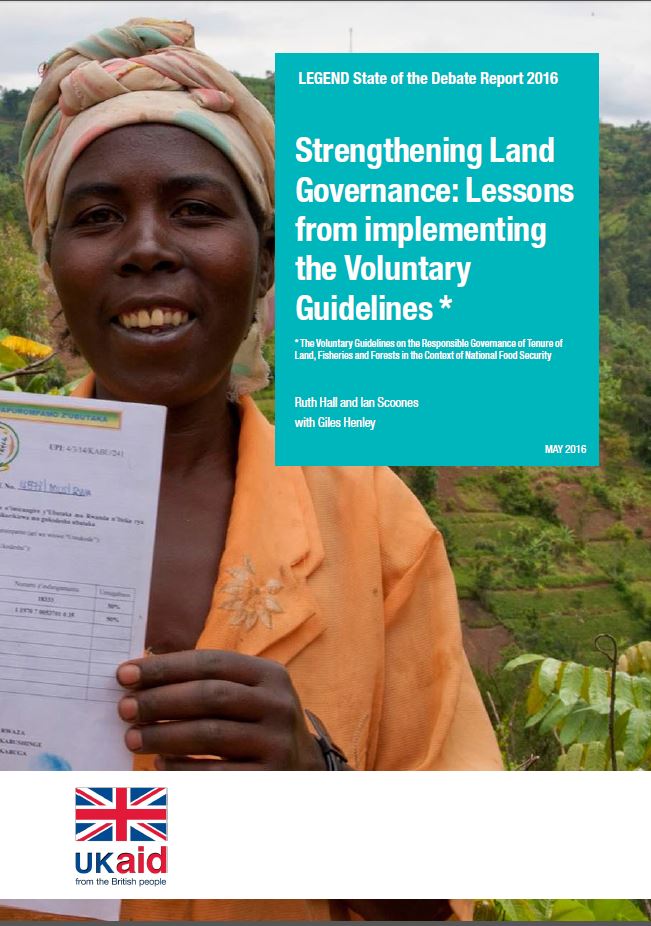
Strengthening Land Governance: Lessons from implementing the Voluntary Guidelines
The Voluntary Guidelines on Responsible Governance of Tenure of Land, Fisheries and Forests in the Context of National Food Security (VGGT) are a globally negotiated and agreed framework endorsed in the Committee on World Food Security (CFS) in 2012.
The VGGT represent agreement on the minimum standards for land governance. While voluntary, they constitute a global consensus on a set of norms. They reflect knowledge and lessons learnt from decades of work on land tenure and governance of natural resources. Now, four years on, what has been done to realise these principles? What are the current debates surrounding implementation of the VGGT? What challenges and obstacles have emerged, and how are they being addressed and resolved?
Labels:
food,
land ownership,
policy
Friday, 6 May 2016
Agro-ecology in Cuba (online)
The Paradox of Cuban Agriculture
When Cuba faced lost trade relations with the Soviet Bloc in the early 1990s, food production collapsed due to the loss of imported fertilizers, pesticides, tractors, parts, and petroleum. Cuba posted the worst growth in per capita food production in Latin America. But the island rapidly re-oriented its agriculture to become a world-class case of ecological agriculture. Cuba rebounded to show the best food production performance in Latin America over the following period, a remarkable annual growth rate of 4.2 percent per capita, a period in which the regional average was 0 percent.
Labels:
agriculture,
food
Tuesday, 1 July 2014
Moving to sustainable eating habits (report)
Changing what we eat: A call for research & action on widespread adoption of sustainable healthy eating
Government leadership and substantial investment in research are needed to shift global consumption habits towards eating patterns that are both healthy and sustainable, say academics, industry and NGOs representatives in this report. Research is now needed in three key areas, say those involved in the report:
- What are healthy sustainable eating patterns?
- How do we eat now, why, and what are the health and sustainability implications?
- How do we achieve positive change?
Wednesday, 18 June 2014
Food movements as social networks (#journal)
The food movement in Canada: a social movement network perspective
In the Global North, there has been increasing analysis of the ways that alternative food initiatives (AFIs) are developing viable, place-based solutions that challenge the corporate-led industrial food system; however, there has been little study of the interrelationships among them. In an effort to better understand the possibilities for food system transformation, this paper builds on existing studies to investigate the increasing collaborations among AFIs occurring through provincial food networks in Canada. Contrary to assumptions that AFIs act in isolation, the paper demonstrates that they are part of actual and existing mobilizations through robust social movement networks. Together, these collaborative efforts may be illustrative of a new wave in food activism that is represented by the emergence of a multi-scaled and cross-sectoral ‘food movement’ – a network of networks.Creating a small cheese business (book)
The Small-Scale Cheese Business: The Complete Guide to Running a Successful Farmstead Creamery
There has never been a better time to be making and selling great cheese. People worldwide are consuming more high- quality, handmade cheese than ever before. The number of artisan cheesemakers has doubled in recent years, and many of the industry’s newcomers are “farmstead” producers—those who work only with the milk of their own animals. Drawing from her own and other cheesemakers’ experiences, the author brings to life the story of creating a successful cheesemaking business in a practical, organized manner. Absolutely essential for anyone interested in becoming a licensed artisan cheesemaker, The Small-Scale Cheese Business will also appeal to the many small and hobby-farm owners who already have milking animals and who wish to improve their home dairy practices and facilities.The Small-Scale Cheese Business
The Complete Guide to Running a Successful Farmstead Creamery
by Gianaclis Caldwell
Few career choices lead to such extremes of labor, emotion, and monetary challenge. In The Small-Scale Cheese Business, (originally published as The Farmstead Creamery Advisor in 2010) respected cheesemaker, instructor, and speaker Gianaclis Caldwell walks would-be producers through the many, and often confusing, steps and decisions they will face when considering a career in this burgeoning cottage industry. This book fills the gap that exists between the pasture and cheese plate. It goes far beyond issues of caring for livestock and basic cheesemaking, explaining business issues such as:
- Analyzing your suitability for the Description Prelim/Final Preliminary career;
- Designing and building the cheese facility;
- Sizing up the market;
- Negotiating day-to-day obstacles;
- Ensuring maximum safety and efficiency.
- See more at: http://www.chelseagreen.com/bookstore/item/the_smallscale_cheese_business:paperback#sthash.nz9gPWbV.dpuf
Tuesday, 15 April 2014
The Campaign for Real Farming (online)
Campaign for real farming website
'The Agrarian Renaissance needs new kinds of farms – polycultural, low-input, skills intensive; and these new farms need appropriate markets – generally local, and geared to the small-scale; and overall we need a true food culture – people who truly appreciate what good food is, and are prepared to seek it out.'
The mission statement of this website is reflected in its contents, and unlike many it is kept right up to date.
'The Agrarian Renaissance needs new kinds of farms – polycultural, low-input, skills intensive; and these new farms need appropriate markets – generally local, and geared to the small-scale; and overall we need a true food culture – people who truly appreciate what good food is, and are prepared to seek it out.'
The mission statement of this website is reflected in its contents, and unlike many it is kept right up to date.
Scaling up agroecolgy (report)
Scaling-up agroecological approaches: what, why and how?
The objectives of this paper are:
•To contribute to ongoing debates on agroecological approaches and their centrality for more sustainable agricultural and food systems;
•To provide key evidence and arguments for supporting advocacy work calling for the scaling-up of agroecological approaches.
The paper includes four main parts:
Part I explains what agroecology is, situating it in light of peasant and industrialized agricultures and introducing its three interconnected dimensions as a science, an agricultural approach and a movement. Part II clarifies how scaling-up an agroecological transition can contribute to achieving sustainable agricultural and food systems. Part III identifies the main challenges to be met for scaling-up at a higher stage agroecological approaches.The conclusion formulates recommendations that help in addressing major challenges involved in scaling up agroecological approaches
Tuesday, 25 February 2014
The latest news on climate change (website)
Responding to Climate Change
Developing sustainable food courses for undergrads (#journal)
Development and Evaluation of an Introductory Course in Sustainable Food and Bioenergy Systems
The purpose of this paper is to describe the development, instruction, and evaluation of the undergraduate pilot course, Introduction to Sustainable Food and Bioenergy Systems (SFBS), at Montana State University. Introduction to SFBS is an interdisciplinary, team-taught, experiential education course designed to introduce students to broad array of SFBS-related topics, expose students to career opportunities in these fields, and enable them to establish relationships with food, agriculture, and energy stakeholders. Introduction to SFBS can serve as a model for such curricula. Courses like this can prepare students to become informed, innovative, critical thinkers capable of excelling in a multitude of food, agriculture, and energy-related careers.SWOT analysis of rice-duck farming (#journal)
Theory and reality of integrated rice–duck farming in Asian developing countries: A systematic review and SWOT analysis
Integrated rice–duck farming, in which ducks feed on insects
and weeds in paddies and fertilise rice plants, has been a flagship of
Asian sustainable-agriculture movements. Nevertheless, IRDF is not
spreading rapidly enough to become a successful
alternative agriculture. This paper undertakes a systematic review of experimental IRDF studies to
identify the strengths and weaknesses of, opportunities for and
threats to IRDF. The most recognisable
empirical strength of IRDF is the synergy of rice and ducks. It was
found that the establishment of organic food certification systems
provides an opportunity for IRDF to grow. On the other hand,
labour-intensiveness was found the greatest weakness of IRDF.
In order to make IRDF economically more feasible, the
non-market ecological benefits of IRDF should be internalised through appropriate
policy instruments.
Friday, 17 January 2014
Meat production and global inequality (#journal)
The meat of the global food crisis
The global food crisis runs much deeper than market turbulence; the biophysical contradictions of the industrial grain–oilseed–livestock complex put meat at the centre of the story. Industrial livestock production is the driving force behind rising meat consumption, and the process of cycling great volumes of industrial grains through soaring populations of concentrated animals serves to magnify the land and resource budgets, pollution, and greenhouse gas emissions of agriculture. These dynamics not only reflect disparities but are exacerbating them, foremost through climate change. Thus rising meat consumption and industrial livestock production should be understood together as a powerful long-term vector of global inequality.Alternative food networks (book)
Alternative Food Networks: Knowledge, Practice and Politics
This book reviews the growth of
alternative food networks and their struggle to defend their ethical and
aesthetic values against the standardizing pressures of the corporate
mainstream. It
explores how these movements are "making a difference" and
their possible role as fears of global climate change and food
insecurity intensify. It assesses the different experiences of these
networks in three major arenas: Britain
and Western Europe, the United States, and the global Fair Trade
economy. This comparative perspective runs throughout the book to fully
explore the erosion of the interface between alternative and
mainstream food provisioning. As the era of "cheap food" draws to a
close, analysis of the limitations of market-based social change and the
future of alternative food economies place
this book at the cutting-edge.
Subscribe to:
Posts (Atom)