We are no longer updating the Research Digest. All content remains.
The Permaculture Research Digest has summaries of newly published permaculture-related research. All items are
hyper-linked to the original publication.
The 'January 2013' archive contains 60 items published in 2012.
Items marked with a # have restricted public access, although abstracts are freely available.
Permaculture Research Digest
Showing posts with label climate change. Show all posts
Thursday, 21 July 2016
The global politics of climate change (book)
Labels:
climate change,
politics
Thursday, 30 June 2016
How sustainable is solar PV? (online)
How viable (and sustainable) are solar PV systems? A debate
Post the Paris climate agreement, the world looks to solar energy more than ever to reduce carbon emissions and counter climate change, with multi-billion dollar solar programmes announced by just about every major country. But just how efficient, and environmentally sustainable is the celebrated solar photovoltaic technology? Here’s what eight leading voices have to say.
Labels:
climate change,
emissions
Ernst Gotsch's carbon farm (video)
Life in Syntropy: The story of a transformation
“Life in Syntropy” is a short film that was screened at the Paris climate talks. It tells the story of Brazilian farmer Ernst Gotsch, who bought 1,200 acres of completely deforested land on the edge of the rainforest in 1984 and transformed it into a remarkably biodiverse farm that reverses climate change by sequestering carbon.
Labels:
biodiversity,
climate change,
farming
Wednesday, 29 June 2016
African technique transforms soil fertility
700-year-old West African soil technique could help mitigate climate change
A 700-year-old fertile soil technique could mitigate climate change and revolutionize farming across Africa, say researchers. They discovered that the ancient West African method of adding charcoal and kitchen waste to highly weathered, nutrient poor tropical soils can transform the land into enduringly fertile, carbon-rich black soils which the researchers dub 'African Dark Earths'.
Labels:
africa,
climate change,
farming
Thursday, 16 June 2016
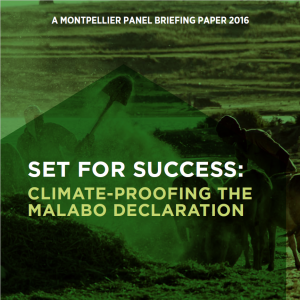
Africa needs climate-proof agriculture (report)
SET FOR SUCCESS: CLIMATE PROOFING THE MALABO DECLARATION (2016)
Montpelier Panel, June 2016
By the year 2050 the impacts of climate change and extreme weather events, such as the current El NiƱo, could increase hunger and child malnutrition by as much as 20%, reversing the gains achieved through the Millennium Development Goal process and jeopardising the success of the Sustainable Development Goals (SDGs).
Agriculture is the backbone of African economies, accounting for as much as 40% of total export earnings and employing 60 – 90% of Africa’s labour force. More than half of households’ income originates in the agriculture sector. Agriculture will continue to be a priority for Africa, alongside efforts towards industrialisation. Using the targets set out in the Malabo Declaration African governments now need to unlock the continent’s agriculture sector in a way that captures the synergies between climate adaptation and mitigation and identifies and reduces the inevitable trade-offs. A sustainable agriculture sector has the potential to contribute to food and nutrition security, poverty reduction and sustained economic growth, in a way that preserves the natural resource base on which it depends.
Climate-smart agriculture needs to:
- Provide adaptation and resilience to shocks
- Generate adaptation and mitigation as co-benefits
- Take a location-specific and knowledge-intensive approach
- Provide integrated options that create synergies and reduce trade-offs.
Recommendation #6 Better training for farmers on sustainable farming techniques, through improved extension services, farmer field schools and utilisation of digital technologies.
...could this mean more permaculture training?!
News coverage of this report here.
Labels:
africa,
climate change,
government,
industrial agriculture
Tuesday, 31 May 2016
Climate change and plant growth (journal)
Vegetation productivity responds to sub-annual climate conditions across semiarid biomes
This is an open-access paper - free to all.
I know it can be daunting reading a scientific paper that is not in your specialised area, so I've added a summary below and a couple of hints on key knowledge to help those who want it. - Naomi.
Article summary
One predicted impact of climate change is longer and more frequent droughts in some areas of the world. The timing of rainfall both over one year (within-year / intra-annual) and over many years (inter-annual) is important in understanding how plant communities might respond.
In this journal paper, researchers looked at responses of grassland, shrubland and forest communities in the semi-arid southwestern USA to prolonged drought. They found that:
- Production in all biomes was impacted by rainfall and temperature
- Higher rainfall is linked with higher production.
- Critical timescales (when production is most affected by temperature and rainfall) are:
- Forests - January through to September.
- Shrubland - July and August.
- Grassland - July through to September
- Production in forests was driven by winter precipitation (which replenishes soil moisture) and limited by maximum summer temperatures.
- Production for shrubs and grassland was driven by summer rainfall and limited by high daily maximum temperatures in summer
- Plant growth increases as temperatures increase to a maximum daily temperature of ~17 degrees C and then rapidly declines when maximum temperatures rise above that.
- It is important to consider both temperature and precipitation patterns when seeking to understand vegetation responses.
Key knowledge and terms used
The balance between temperature and rainfall is directly linked to the kinds of plants that can thrive and ultimately can define biomes at a global level. The hotter it is, the more water a plant needs to use (through evapotranspiration). Broadly speaking - Little rainfall = desert, (high temp like Sahara or low temp like Antarctica); Lots of water and cool temperature = temperature forest; Moderate water and cool temperature = temperate grasslands; Lots of water and high temperature = tropical rainforest.
This paper uses a way of measuring this balance temperature and rainfall called Standardised Precipitation Evapotranspiration Index (SPEI).
Enhanced Vegetation Index (EVI) is a proxy measure of plant growth - it uses satellite data to detect small changes in colour (greenness)
Links to permaculture
Can we use knowledge from natural communities to think about how our natural ecosystems and/or annual crops and forest gardens might respond and how we could adapt? When might be critical to store/use water?
Labels:
climate change,
drought
Monday, 23 May 2016
Climate change impact on the cost of living (report)
This new report examines how climate change
could affect day to day living costs of UK households. A
key finding is that low income households will be most affected by
climate change impacts on the costs of living. The
food bill for an average household could rise by 9% by the 2050s and
this will have a bigger impact on low income households, because their
average household spending on food is higher.
There are also large costs for those affected
by increased flooding, especially for those without insurance which many
low income households lack. In addition, there are higher risks of
flooding in many deprived areas.
Labels:
climate change,
food,
money
Thursday, 19 May 2016
Soil management to mitigate climate change (journal paper)
Climate-smart soils
Improved soil management can substantially reduce greenhouse gas emissions from soils and sequester some of the carbon dioxide removed from the atmosphere by plants, as carbon (C) in soil organic matter. In addition, wise soil management that increases organic matter and tightens the soil nitrogen (N) cycle can yield powerful synergies, such as enhanced fertility and productivity, increased soil biodiversity, reduced erosion, runoff and water pollution, and can help buffer crop and pasture systems against the impacts of climate change. This article highlights ‘state of the art’ soil greenhouse gas
research, summarises mitigation practices and potentials, identifies gaps in data
and understanding and suggests ways to close such gaps through new research,
technology and collaboration.
Improved soil management can substantially reduce greenhouse gas emissions from soils and sequester some of the carbon dioxide removed from the atmosphere by plants, as carbon (C) in soil organic matter. In addition, wise soil management that increases organic matter and tightens the soil nitrogen (N) cycle can yield powerful synergies, such as enhanced fertility and productivity, increased soil biodiversity, reduced erosion, runoff and water pollution, and can help buffer crop and pasture systems against the impacts of climate change.
If you'd like some less technical reading, you might enjoy this summary article.
Although soils contribute a major share (37%; mainly as N2O and CH4) of agricultural emissions3, improved soil management can substantially reduce these emissions and sequester some of the CO2 removed from the atmosphere by plants, as carbon (C) in soil organic matter (in this Perspective, our discussion of soil C refers solely to organic C). In addition to decreasing GHG emissions and sequestering C, wise soil management that increases organic matter and tightens the soil nitrogen (N) cycle can yield powerful synergies, such as enhanced fertility and productivity, increased soil biodiversity, reduced erosion, runoff and water pollution, and can help buffer crop and pasture systems against the impacts of climate change4.Although soils contribute a major share (37%; mainly
as N
2
O and CH
4
) of agricultural emissions
3
, improved soil management
can substantially reduce these emissions and sequester some of the CO
2
removed from the atmosphere by plants, as carbon (C) in soil organic
matter (in this Perspective, our discussion of soil C refers solely to
organic C). In addition to decreasing GHG emissions and sequestering C,
wise soil management that increases organic matter and tightens the
soil nitrogen (N) cycle can yield powerful synergies, such as enhanced
fertility and productivity, increased soil biodiversity, reduced erosion,
runoff and water pollution, and can help buffer crop and pasture systems
against the impacts of climate change
4
.
Although soils contribute a major share (37%; mainly
as N
2
O and CH
4
) of agricultural emissions
3
, improved soil management
can substantially reduce these emissions and sequester some of the CO
2
removed from the atmosphere by plants, as carbon (C) in soil organic
matter (in this Perspective, our discussion of soil C refers solely to
organic C). In addition to decreasing GHG emissions and sequestering C,
wise soil management that increases organic matter and tightens the
soil nitrogen (N) cycle can yield powerful synergies, such as enhanced
fertility and productivity, increased soil biodiversity, reduced erosion,
runoff and water pollution, and can help buffer crop and pasture systems
against the impacts of climate change
4
.
Labels:
climate change,
emissions,
soil
Subscribe to:
Posts (Atom)
