Showing posts with label research agenda. Show all posts

Thursday, 21 August 2014

Permaculture Research Handbook (online)

The Permaculture Research Handbook


The Permaculture Research Handbook is aimed at those with some knowledge of permaculture but no research background who want to undertake a permaculture research project, whether as diploma apprentices, undergraduates, volunteers, or just for fun. The Handbook uses the SADIMETS model of seven straightforward steps (survey, analyse, design, implement and maintain, evaluate, tweak, and share) to guide the reader through the research process, from the first project idea to a published final report. 7 experienced permaculture designers and researchers collaborated to produce the handbook. It is free to download.

Wednesday, 16 July 2014

Permaculture International Research Network launched!

The Permaculture International Research Network (PIRN) is launched! 

This week The Permaculture Association is launching what we believe is the world's first Permaculture International Research Network. Our first e-bulletin is going out to around 400 permaculture researchers on Friday 18th July 2014. PIRN has three initial activities; an e-bulletin issued six times a year, a facebook page, and the international soil trials. Currently the network is in beta stage; the full launch will take place in September 2015 at The International Permaculture Convergence in London. Anyone involved in permaculture research can join in the conversation on the facebook page; but if you want to actually join PIRN (its free!) and receive the e-bulletin, please e-mail: pirn@permaculture.org.uk

Scientists call for agroecology research (online)

Scientists Call for Public Investment in Agroecological Research


A distinguished group of scientists and experts from universities and colleges across the United States—including land-grant universities in agricultural powerhouse states such as Iowa and California—has launched the following statement calling for increased public investment in agroecological research. Their statement describes agroecological methods as productive, profitable and sustainable.

Monday, 30 June 2014

Healing the world with permaculture (#journal)

Feeding and healing the world: through regenerative agriculture and permaculture.

The study of soil is a mature science, whereas related practical methods of regenerative agriculture and permaculture are not. However, despite a paucity of detailed peer reviewed research published on these topics, there is overwhelming evidence both that the methods work and they may offer the means to address a number of prevailing environmental challenges. What is lacking is a proper scientific study, made in hand with actual development projects. By elucidating the scientific basis of these remarkable phenomena, we may obtain the means for solving some of the otherwise insurmountable problems confronting humanity, simply by observing, and working with, the patterns and forces of nature. This article is intended as a call to arms to make serious investment in researching and actualising these methods on a global scale. Permaculture and regenerative agriculture offer potentially the means to provide food and materials on the small scale, and may provide a crucial strategy in achieving a measured descent in our use of energy and other resources, rather than an abrupt collapse of civilization.

Wednesday, 18 June 2014

Build topsoil to stop climate change (book)


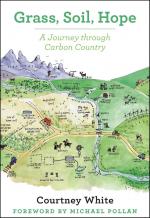
Grass, Soil, Hope A Journey Through Carbon Country


What can we do about the seemingly intractable challenges confronting all of humanity today, including climate change, global hunger, water scarcity, environmental stress, and economic instability?
The quick answers are: Build topsoil. Fix creeks. Eat meat from pasture-raised animals. Soil scientists maintain that a mere 2 percent increase in the carbon content of the planet’s soils could offset 100 percent of all greenhouse gas emissions going into the atmosphere. But how could this be accomplished? What would it cost? Is it even possible?
Yes, says author Courtney White, it is not only possible, but essential for the long- term health and sustainability of our environment and our economy. Soil is a huge natural sink for carbon dioxide. If we can draw increasing amounts carbon out of the atmosphere and store it safely in the soil then we can significantly address all the multiple challenges that now appear so intractable.

Grass, Soil, Hope A Journey Through Carbon Country
Where people are fighting climate change and growing food with pasture cropping, permaculture, wetland restoration, rooftop farms, biodiesel, beer, and sweaty dancing.
This book tackles an increasingly crucial question: What can we do about the seemingly intractable challenges confronting all of humanity today, including climate change, global hunger, water scarcity, environmental stress, and economic instability?
The quick answers are: Build topsoil. Fix creeks. Eat meat from pasture-raised animals. Soil scientists maintain that a mere 2 percent increase in the carbon content of the planet’s soils could offset 100 percent of all greenhouse gas emissions going into the atmosphere. But how could this be accomplished? What would it cost? Is it even possible?
Yes, says author Courtney White, it is not only possible, but essential for the long- term health and sustainability of our environment and our economy.
Right now, the only possibility of large-scale removal of greenhouse gases from the atmosphere is through plant photosynthesis and related land-based carbon sequestration activities. These include a range of already existing, low- tech, and proven practices: composting, no-till farming, climate-friendly livestock practices, conserving natural habitat, restoring degraded watersheds and rangelands, increasing biodiversity, and producing local food.
In Grass, Soil, Hope, the author shows how all these practical strategies can be bundled together into an economic and ecological whole, with the aim of reducing atmospheric CO2 while producing substantial co- benefits for all living things. Soil is a huge natural sink for carbon dioxide. If we can draw increasing amounts carbon out of the atmosphere and store it safely in the soil then we can significantly address all the multiple challenges that now appear so intractable.
- See more at: http://www.chelseagreen.com/bookstore/item/grass_soil_hope:paperback#sthash.fv33yYXv.dpuf

Agronomy with global impact (#journal)

 Global agronomy, a new field of research. A review

Agriculture management is influencing the quality of water, air, soil, and biodiversity at the global scale. Therefore, a research plan for global agronomy is proposed. Agronomists should update their research objects, methods, and tools to address global issues. Yield trends and variations among various regions should be analyzed to understand the sources of these variations. Crop model simulations should be upscaled to estimate potential yields and to assess the effect of climate change and resource scarcity at the global scale. Advanced methods should analyze output uncertainty of complex models used at a global scale. The meta-analysis of published data is a promising approach for addressing global issues, though meta-analysis must be applied carefully with appropriate techniques. Finally, global datasets on the performance and environmental impact of cropping systems should be developed.