We are no longer updating the Research Digest. All content remains.
The Permaculture Research Digest has summaries of newly published permaculture-related research. All items are
hyper-linked to the original publication.
The 'January 2013' archive contains 60 items published in 2012.
Items marked with a # have restricted public access, although abstracts are freely available.
Permaculture Research Digest
Thursday, 21 July 2016
2050: a low carbon society (book)
Labels:
case studies,
emissions,
energy
The global politics of climate change (book)
Climate Change in World Politics
A multi-faceted view of climate change from an International Relations, global governance, justice, sustainable development and national identity perspective. John Vogler examines the international politics of climate change, with a focus on the United Nations Framework Convention (UNFCCC). He considers how the international system treats the problem of climate change, analysing the ways in which this has been defined by the international community and the interests and alignments of state governments.
Labels:
climate change,
politics
Permaculture your life (book)
How to Permaculture Your Life: Strategies, Skills and Techniques for the Transition to a Greener World by Ross Mars
This book is a great resource for everyone interested in Transition, permaculture and more self-reliant and satisfying lifestyles. It is packed with information on permaculture design principles, soil building, nutrient-dense food growing, including top plant and tree selections for all climatic zones. Coverage extends to rainwater harvesting and irrigation, human waste management, and strategies for rural properties plus a unique focus on applying permaculture to small urban spaces. Also covered are hand tools, food preservation, energy production, and low-carbon housing and a plethora of nearly forgotten skills such as soap making, basket weaving, seed saving, and rope and candle making, and more
Labels:
behaviour change,
design,
lifestyle,
permaculture
Thursday, 7 July 2016
Time lapse film of woodland plants (video)
Time-lapse of woodland plant emergence
Just for fun - and to remind you of the wonder of nature- from BBC's 'Private Life of Plants' (1.5 mins)
Critquing the green economy (book)
Inside The Green Economy: Promises and Pitfalls
The economic and ecological bases of a general prosperity are in danger, the gap between rich and poor is widening. The concept of the Green Economy offers a new model, based primarily on large-scale technological solutions. But the Green Economy cares little about politics, barely registers human rights, does not recognize social actors and suggests the possibility of reform without conflict. It suggests that the world as we know it can continue with green growth.
But can efficiency be a solution if it results in even more consumption? Is it possible to save nature by putting a price on the services it provides? Should we rely on magical technological solutions to save us? This book puts the Green Economy to the test, discusses its promises, describes actual consequences and names its blind spots. It is an invitation to embrace radical optimism to find transformative strategies for a livable future.
Tuesday, 5 July 2016
Securing affordable farm land in the UK (video)
The Ecological Land Cooperative
The Ecological Land Co-operative (ELC) was set up to address the lack of affordable sites for ecological land based livelihoods in England. This short film introduces you to the ELC staff and the smallholders at their first project site, Greenham Reach, in Devon, UK.
Labels:
finance,
land ownership,
small holding,
video
Friday, 1 July 2016
Agriculture and aquaculture combat rising sea levels (news report)
Bangladesh agriculture adapts to sea-level rise
A continuous influx of sea water is threatening agriculture and food security in vast coastal areas of Bangladesh, but farmers are finding ways to adapt, like cultivating fish and crops at the same time.
The coastal and offshore areas of this low-lying, densely populated country include tidal estuaries and river floodplains in the south along the Bay of Bengal. Here the arable land is about 30 percent of the total available in the country.
According to salinity survey findings, about one million hectares, or about 70 percent of cultivated lands of the southern coastal areas of Bangladesh, are affected by various degrees of soil salinity.
It is already predicted that if the current trend of climate change continues, rice production could fall by 10 percent and wheat by 30 percent.
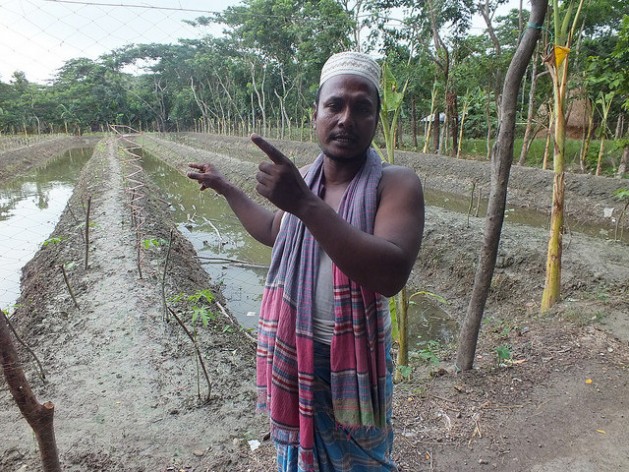
Coastal Integrated Technology Extension Programme (CITEP) encourages farmers to use the Sarjan model of long raised rows of soil about one metre wide and 90 cm high for cultivating varieties of vegetables. The trenches between the rows are filled with water into which various types of fish are released for maturing. The water for irrigating the plants comes from nearby lakes filled with freshwater drawn from the Meghna River.
The advantage of using Sarjan model is that it protects cropland from inundation during storm surges, tidal waves and flash flooding and avoids high salinity.
The new farming practice has turned out to be very popular in Char Fasson, where over 9,000 farmers are now using the model. Many farmers have also formed self-help groups where members benefit from sharing each others’ experiences.
Reflections
Is this a permaculture-allied solution? Could it be used elsewhere?
Are you doing permaculture in this region? If so, we'd love to hear more about it. Please get in touch with Naomi on international@permaculture.org.uk
Subscribe to:
Posts (Atom)