What can we do
about the seemingly intractable challenges confronting all of
humanity today, including climate change, global hunger, water
scarcity, environmental stress, and economic instability?
The quick answers are: Build topsoil. Fix creeks. Eat meat from
pasture-raised animals. Soil scientists maintain that a mere 2
percent increase in the carbon content of the planet’s soils could
offset
100 percent of all greenhouse gas emissions going
into the atmosphere. But how could this be accomplished? What would
it cost? Is it even possible?
Yes, says author Courtney White, it is not only possible, but
essential for the long- term health and sustainability of
our environment and our economy. Soil
is a huge natural sink for carbon dioxide. If we can draw increasing
amounts carbon out of the atmosphere and store it safely in the soil
then we can significantly address all the multiple challenges that
now appear so intractable.
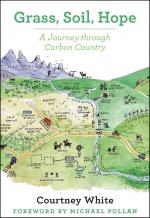
Grass, Soil, Hope
A Journey Through Carbon Country
Where
people are fighting climate change and growing food with pasture
cropping, permaculture, wetland restoration, rooftop farms, biodiesel,
beer, and sweaty dancing.
This book tackles an increasingly crucial question: What can we do
about the seemingly intractable challenges confronting all of humanity
today, including climate change, global hunger, water scarcity,
environmental stress, and economic instability?
The quick answers are: Build topsoil. Fix creeks. Eat meat from
pasture-raised animals. Soil scientists maintain that a mere 2 percent
increase in the carbon content of the planet’s soils could offset 100 percent of
all greenhouse gas emissions going into the atmosphere. But how could
this be accomplished? What would it cost? Is it even possible?
Yes, says author Courtney White, it is not only possible, but essential for the long- term health and sustainability of our environment and our economy.
Right now, the only possibility of large-scale removal of greenhouse
gases from the atmosphere is through plant photosynthesis and related
land-based carbon sequestration activities. These include a range of
already existing, low- tech, and proven practices: composting, no-till
farming, climate-friendly livestock practices, conserving natural
habitat, restoring degraded watersheds and rangelands, increasing
biodiversity, and producing local food.
In Grass, Soil, Hope, the author shows how all these
practical strategies can be bundled together into an economic and
ecological whole, with the aim of reducing atmospheric CO2
while producing substantial co- benefits for all living things. Soil is a
huge natural sink for carbon dioxide. If we can draw increasing amounts
carbon out of the atmosphere and store it safely in the soil then we
can significantly address all the multiple challenges that now appear so
intractable.
- See more at: http://www.chelseagreen.com/bookstore/item/grass_soil_hope:paperback#sthash.fv33yYXv.dpuf