Thursday, 19 May 2016

'The Green Economy'; a smokescreen for destruction (online)

The “Green Economy”: giving immunity to criminals

For over a decade, international policy debate has been re-defining forests as providers of “ecosystem services”. Promotional videos, slogans and attractive brochures promoting a “Green Economy”, repeat how forests and biodiversity are essential for the “services” they provide to humanity. This reinforces the colonial understanding of “nature” as a collection of species, undisturbed by human interaction, denying the role of forest peoples in shaping nature, and putting “nature” at the service of the same economy that continues to destroy it. The result is a re-definition that reduces the underlying causes of the destruction of forests and other territories into an issue of numbers. These discourses silence the crucial issues of power relations, including the underlying causes of forest destruction and violation of forest communities’ rights. People, cultures, traditions, interconnections are not even considered as co-existing and inseparable with forests.

A detailed report that provides a damning analysis of one 'biodiversity offset' project can be found here.

First UN World Cities Report (report)


Urbanization and Development: Emerging Futures

The analysis of urban development of the past twenty years presented in this maiden edition of the World Cities Report shows, with compelling evidence, that there are new forms of collaboration and cooperation, planning, governance, finance and learning that can sustain positive change. The Report unequivocally demonstrates that the current urbanization model is unsustainable in many respects. It conveys a clear message that the pattern of urbanization needs to change in order to better respond to the challenges of our time, to address issues such as inequality, climate change, informality, insecurity, and the unsustainable forms of urban expansion.

Tuesday, 17 May 2016

Bioenergy carbon capture; a viable option? (report)

Last-ditch climate option or wishful thinking? Bioenergy with Carbon Capture and Storage

BECCS is being proposed as a way of removing billions of tonnes of carbon every year from the atmosphere.  It would involve capturing CO2 from biomass burning power plants or biofuel refineries and pumping it underground.  The report examines the different BECCS technologies proposed, and the role of the International Panel on Climate Change (IPCC) in this debate. So far, the only (very small scale) BECCS projects have involved capturing some CO2 from ethanol refining, The report looks in detail at the technical and economic viability of the technologies involved, at the credibility of the idea that large-scale BECCS could be carbon-negative, at the evidence regarding the reliability of carbon storage and at the greenhouse gas impacts.

Monday, 16 May 2016

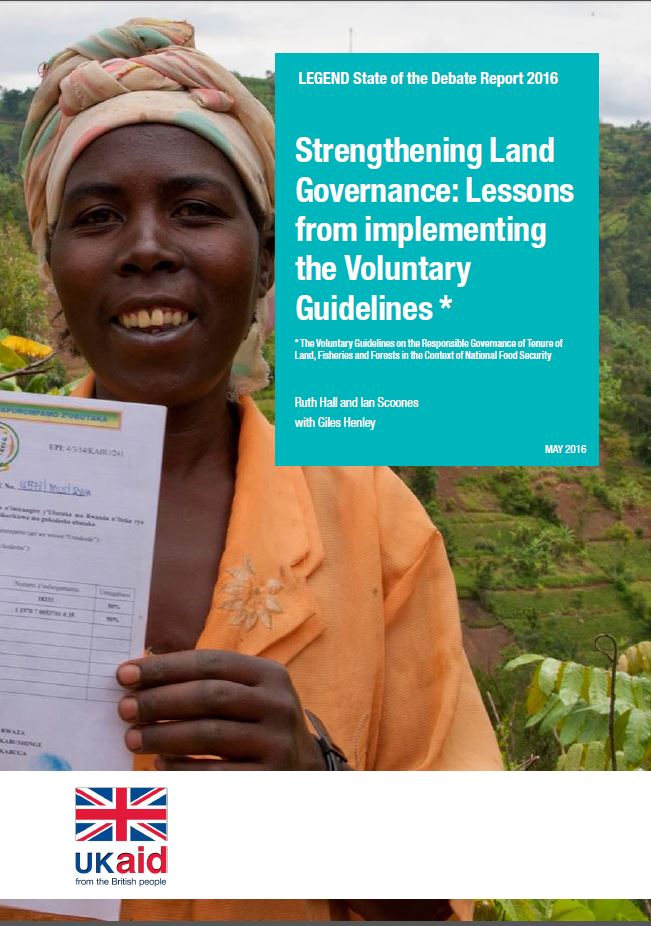
International guidelines on land governance (report)

Strengthening Land Governance: Lessons from implementing the Voluntary Guidelines

The Voluntary Guidelines on Responsible Governance of Tenure of Land, Fisheries and Forests in the Context of National Food Security (VGGT) are a globally negotiated and agreed framework endorsed in the Committee on World Food Security (CFS) in 2012.

The VGGT represent agreement on the minimum standards for land governance. While voluntary, they constitute a global consensus on a set of norms. They reflect knowledge and lessons learnt from decades of work on land tenure and governance of natural resources. Now, four years on, what has been done to realise these principles? What are the current debates surrounding implementation of the VGGT? What challenges and obstacles have emerged, and how are they being addressed and resolved?


Agricultural investment data worldwide (report)

Agricultural Investment Data - Landscape Analysis: Executive summary

Investments in agriculture are critical to reducing poverty and improving food security and nutrition. Although billions of dollars are spent on these investments every year, comprehensive and detailed information on these investments is still largely unavailable. This study explores the current landscape of data on agricultural investments. In doing so, it identifies key opportunities and challenges in working for a clearer and more reliable picture of agricultural investments worldwide.

Humus may not exist! (#journal)

Humus doesn't exist?

According to a post by Toby Hemenway, several recent articles are showing that humic and fulvic acids and many of the other humic components of soil are artifacts of the alkaline treatment that is used to measure humus content, and don't, in fact, exist in untreated soil. When OM is measured using non-destructive methods such as NMR spectroscopy, no humic compounds can be found. Organic matter does not degrade into "stable" humic components, it simply decomposes into a continuum of smaller and smaller carbon compounds. There is constant, slow turnover of carbon in soils, not a semi-permanent trapping of carbon into "humus." Humus, meaning a stable form of carbon visualized by alkaline extraction, seems not to exist. Most of the articles on this are behind journal paywalls, but some of the abstracts are available. One article is Lehmann, J.; Kleber, M. (2015-12-03), "The contentious nature of soil organic matter", Nature 528:60-68.

Agroecology in the tropics (journal)

The Role of Trees in Agroecology and Sustainable Agriculture in the Tropics

Shifting agriculture in the tropics has been replaced by sedentary smallholder farming on degraded land. To address low yields and low income both, the soil fertility, the agroecosystem functions, and the source of income can be restored by diversification with nitrogen-fixing trees and the cultivation of indigenous tree species. Biodiversity studies indicate that mature cash crop systems, such as cacao and coffee with shade trees, provide wildlife habitat that supports natural predators. This review offers suggestions on how to examine these agroecological processes in more detail for the most effective rehabilitation of degraded land.