Thursday, 21 November 2013

Getting the best from your woodburner (book)
The Log Book: getting the best from your woodburning stove.

A cultural history of sustainability (book)
Sustainability: A Cultural History

Household waste and what happens to it (film)
Trashed
The first feature-length film to feature on The Digest!
“Trashed” is a provocative investigation of one of
the fastest growing industries in North America. The garbage business.
The film examines a fundamental element of modern American culture…the
disposal of what our society defines as “waste.” It is an issue
influenced by every American, most of whom never consider the
consequences. Nor, it seems, the implications to our biosphere. At times
humorous, but deeply poignant, “Trashed” examines the American waste
stream fast approaching a half billion tons annually. What are the effects all this waste will have
on already strained natural resources? Why is so much of it produced?
While every American creates almost 5 pounds of it every day, who is
affected most? And who wants America to make more?
Keeping a famliy cow (book)
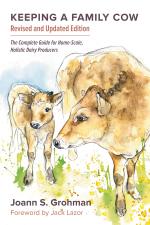
Keeping a Family Cow: The Complete Guide for Home-Scale, Holistic Dairy Producers
The
cow is the most productive, efficient creature on earth. She gives you
fresh milk, cream, butter, and cheese, and promotes human health and
happiness. She helps the homesteaders and small farmers who offer her
bounty up to the community with a chance at turning a profit. She
provides rich manure for your garden or land, and enriches the quality
of your life as you benefit from the resources of the natural world.
Originally published in the early 1970s as The Cow Economy and reprinted many times since, Keeping a Family Cow is the book that launched thousands of holistic small-scale dairy farmers and families raising healthy cows in accordance with their true nature.
- See more at: http://www.chelseagreen.com/bookstore/item/keeping_a_family_cow:paperback#sthash.HIb7uN8Y.dpuf
Originally published in the early 1970s as The Cow Economy and reprinted many times since, Keeping a Family Cow is the book that launched thousands of holistic small-scale dairy farmers and families raising healthy cows in accordance with their true nature.
- See more at: http://www.chelseagreen.com/bookstore/item/keeping_a_family_cow:paperback#sthash.HIb7uN8Y.dpuf
Biggest permaculture literature review ever published (journal)
Permaculture for agroecology: design, movement, practice, and worldview. A review
Permaculture is an agroecological movement with a broad international distribution and a unique approach to system design. Despite a high public profile, permaculture has remained relatively isolated from scientific research. Though the potential contribution of permaculture to agroecological transition is great, it is limited by this isolation from science, as well as from oversimplifying claims, and the lack of a clear definition. Here, we review scientific and popular permaculture literature. A systematic review discusses quantitative bibliometric data, including keyword analysis. A qualitative review identifies and assesses major themes, proposals, and claims. The manuscript follows a stratified definition of permaculture as design system, best practice framework, worldview, and movement.
Silvopasture is the future for livestock (journal)
Sustainable, efficient livestock production with high biodiversity and good welfare for animals

What is the future for livestock agriculture in the world? Consumers have concerns about sustainability but many widely used livestock production methods do not satisfy consumers' requirements for a sustainable system. However, production can be sustainable, occurring in environments that: supply the needs of the animals resulting in good welfare, allow coexistence with a wide diversity of organisms native to the area, minimize carbon footprint and provide a fair lifestyle for the people working there. Silvopastoral systems, pastures with shrubs and trees as well as herbage, are described which are normally more productive than pasture alone. When compared with widely used livestock production systems, silvopastoral systems can provide efficient feed conversion, higher biodiversity, enhanced connectivity between habitat patches and better animal welfare, so they can replace existing systems in many parts of the world and should be further developed.
Subscribe to:
Posts (Atom)