Wednesday, 1 April 2020
The hidden potential of urban horticulture (report)
The hidden potential of urban horticulture
Urban areas offer considerable potential for horticultural food production, but questions remain about the availability of space to expand urban horticulture and how to sustainably integrate it into the existing urban fabric. We explore this through a case study which shows that, for a UK city, the space potentially available equates to more than four times the current per capita footprint of commercial horticulture.

Friday, 20 December 2019
Agroecology for peace building (report)
Agroecology as a Practice-Based Tool for Peacebuilding in Fragile Environments? Three Stories from Rural Zimbabwe
Three case studies are presented, drawing on
primary data from participatory action research with farming communities
in Zimbabwe that also consider the differential attitudes and
experiences of agroecological and conventional farmers. The study finds
that, where agroecological farmers were exposed to more plural ways of
thinking, being and acting together, levels of autonomy from coercive
structures were increasing, as were both a sense of efficacy and
optimism to effect social–ecological change. In these cases,
agroecological farmers were increasingly able to envisage a future
together shaped by collective endeavour, evidenced by changing attitudes
and relationships with one another and their environment. The paper
explores the extent to which farmers in each location were able to
instrumentalise resilience and agency for everyday peace, and the
variances found according to historical context and local power dynamics
that represent barriers to change.
Agroecology and climate resilience (report)
The contribution of agroecological approaches to realizing climate-resilient agriculture
It is generally accepted that agriculture is a major driver of climate change as well as being acutely challenged to adapt to its effects. Agroecological approaches involve the application of integrated ecological, economic and social principles to the transition of smallholder farming systems, towards greater resilience. This involves adapting 13 generic agroecological principles to local circumstances. Agroecology comprises transdisciplinary science; sustainable agricultural practices; and, social movements that are precipitating widespread behaviour change. Agroecological principles map closely to principles of adaptation with the notable exception that while they often exhibit resilience benefits, these are incidental rather than representing an explicit response to climate signals.Agroecology manifests at field, farm and landscape scales, for which different metrics of agricultural performance are relevant in order for agroecological practices to be fairly judged against alternatives.
2nd Agroecology Forum Europe (report)
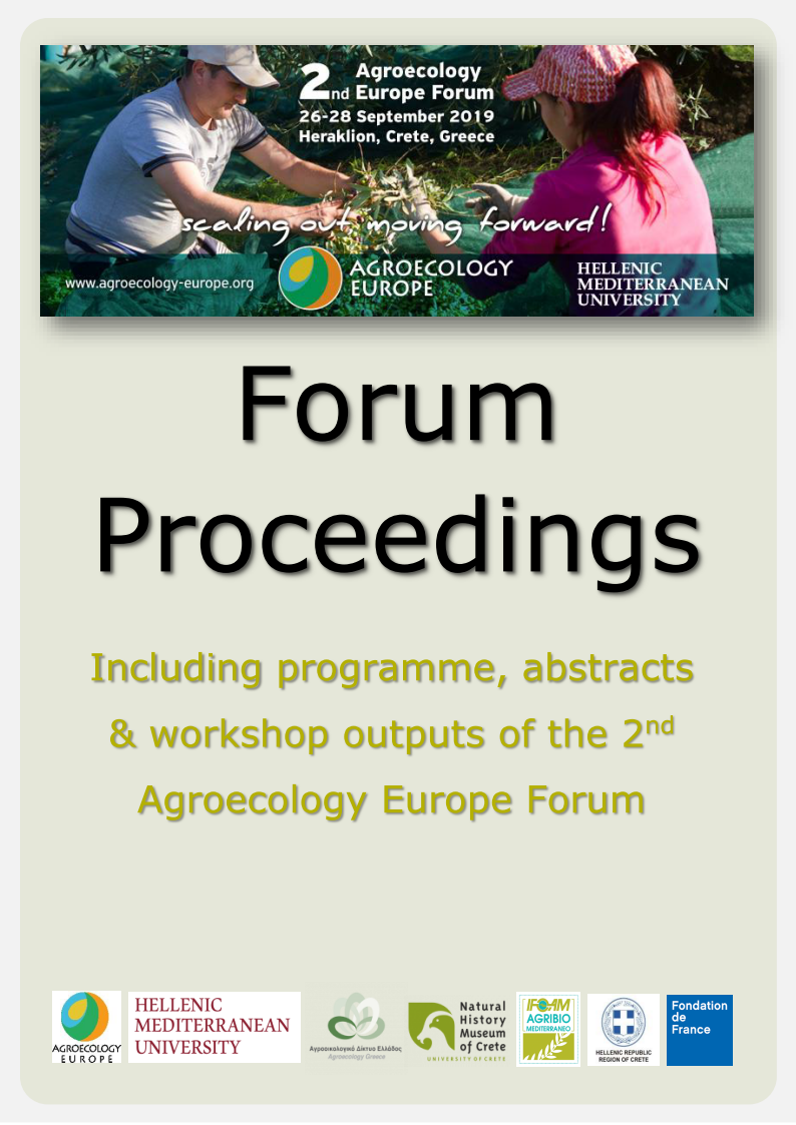
Second Agroecology Europe Forum
Tuesday, 29 October 2019
Crop-livestock agroforestry systems (#journal)
Integrated crop–livestock systems with agroforestry to improve organic animal farming
The livestock sector has to satisfy the growing demand for animal products while reducing its environmental impact, in face of great climatic and market changes. For this reason, there is a necessity to redesign livestock production systems in order to make them more sustainable and adaptable. IFS (crop-livestock-trees) could be a viable option to achieve the above mentioned global goals. Moreover, the implementation of conservation agriculture practices proved to improve crop-livestock beneficial effects. This review paper aims at highlighting the scientific knowledge existing regarding the advantages and limitations of crop-livestock systems including agroforestry and conservation agriculture practices. This shows that integration can be a positive approach to achieve farm’s sustainability.
Polycultures store more soil carbon (journal)
Microbial spatial footprint as a driver of soil carbon stabilization
Increasing the potential of soil to store carbon (C) is an acknowledged strategy for capturing atmospheric CO2. Yet experimental evidence often fails to support anticipated C gains. Here, authors demonstrate for the first time that plant-stimulated soil pore formation appears to be a major, hitherto unrecognized, determinant of whether new C inputs are stored or lost. Unlike monocultures, diverse plant communities favor the development of 30–150 µm pores. Such pores are the micro-environments associated with higher enzyme activities, and greater abundance of such pores translates into a greater spatial footprint that microorganisms make on the soil and consequently soil C storage capacity.
The potential of forest gardens (#journal)
Exploring the potential of edible forest gardens: experiences from a participatory action research project in Sweden
 To meet the environmental challenges that are presently confronting society, the narrow focus on agricultural production needs to be altered to one that places equal value on the generation of crucial ecosystem services. Current research shows that perennial intercropping systems such as agroforestry may be a feasible alternative. Based on studies during the establishment of edible forest gardens in 12 participating farms in Sweden, this paper explores the potential of utilizing multi-strata designs for food production in temperate, high-income countries. Design and species composition of such gardens, types of food they provide, and how they would best fit into the present landscape are discussed. Large knowledge gaps concerning potential production, social and economic benefits, and agronomic issues were identified.
US agriculture is destroying insect life (online)
New study: U.S. agriculture 48 times more toxic to insects than 25 years ago
A new peer-reviewed study shows an explosion in the toxicity of U.S. agriculture for insects over the past 25 years since neonicotinoid pesticides were introduced. The study found that U.S. agriculture is 48 times more toxic to insect life, and that neonicotinoids account for 92 percent of the increase in toxicity.
Published in the journal PLOS ONE, An assessment of acute insecticide toxicity loading of chemical pesticides used on agricultural land in the United States,
is the first study to quantify how hazardous our agricultural lands
have become for insect life by providing a way to compare changes in the
toxicity of U.S. agriculture year-to-year. The increase in toxic load measured by
the study is consistent with recent reports of dramatic declines in
beneficial insects and bird populations. The study comes on the heels of
the first meta-analysis
of global insect decline, which found that 40 percent of insect species
face extinction in coming decades, leading the authors to warn of
“catastrophic ecosystem collapse” if we don’t change the way we farm.
AgroecologyNow! (online)
AgroecologyNow!
AgroecologyNow! is an initiative convened by the Centre for Agroecology, Water and Resilience in the United Kingdom working with partners including social movements, civil society, governments and research institutions to promote a transformative agroecology for food sovereignty and social justice. It is based on the commitment to co-producing and mobilising knowledge with civil society organisations, intergovernmental bodies, policy-makers, researchers and food producers to advance societal transformations for agroecology. Work especially stresses the importance of People's Knowledge in societal transformation and using participatory, transdisciplinary and action oriented approaches to research.
AgroecologyNow! is an initiative convened by the Centre for Agroecology, Water and Resilience in the United Kingdom working with partners including social movements, civil society, governments and research institutions to promote a transformative agroecology for food sovereignty and social justice. It is based on the commitment to co-producing and mobilising knowledge with civil society organisations, intergovernmental bodies, policy-makers, researchers and food producers to advance societal transformations for agroecology. Work especially stresses the importance of People's Knowledge in societal transformation and using participatory, transdisciplinary and action oriented approaches to research.
Traditional food systems prevent malnutrition (report)

This report authored by members of the Food Sovereignty Alliance India along with the Catholic Health Association of India is an in-depth analysis of the traditional diets of marginal farmers, landless and agro-pastoralists.
The enquiry provided clear evidence of the following:
- Marginal farming communities continue to be a rich repository of knowledge, resilient food systems, biodiversity and agro-ecology.
- Their food systems are nutritionally diverse and rich in nutrients.
- These traditional food systems have been eroded over time.
- Land, water and forest rights are seriously under threat.
- Lived experience and knowledge is an integral part of lives and livelihoods and socio-ecological resilience.
First peer reviewed permaculture book - free! (Download)
The Permaculture Student 2
The first peer-reviewed permaculture textbook EVER and the first cited and referenced global permaculture textbook since Bill Mollison's 1989 Permaculture: A Designer's Manual. Representing & collaborating with dozens of experts & organizations from around the world, Matt Powers' latest installment in his series of curriculum takes permaculture to a new level & organizes all regenerative techniques & methodologies into one clear, understandable system that also serves as a path to deeper study. Download it FREE.
The amazing evolution of oak trees (online)
Evolutionary history of oaks

Monday, 30 September 2019
An agroecological Europe by 2050 (report)
An agroecological Europe in 2050: multifunctional agriculture for healthy eating
This report explores the possibility of generalising agroecology to a European scale. An original quantitative model makes it possible to analyse retrospectively the functioning of the European food system and to quantify an agroecological scenario by 2050 by testing the implications of different hypotheses. The core scenario is based on the widespread adoption of agroecology, the phasing-out of vegetable protein imports and the adoption of healthier diets by 2050. Despite an induced drop in production of 35% compared to 2010, this scenario: - provides healthy food for Europeans while maintaining export capacity; - reduces Europe's global food footprint; - leads to a 40% reduction in GHG emissions from the agricultural sector; - regains biodiversity and conserves natural resources.
This report explores the possibility of generalising agroecology to a European scale. An original quantitative model makes it possible to analyse retrospectively the functioning of the European food system and to quantify an agroecological scenario by 2050 by testing the implications of different hypotheses. The core scenario is based on the widespread adoption of agroecology, the phasing-out of vegetable protein imports and the adoption of healthier diets by 2050. Despite an induced drop in production of 35% compared to 2010, this scenario: - provides healthy food for Europeans while maintaining export capacity; - reduces Europe's global food footprint; - leads to a 40% reduction in GHG emissions from the agricultural sector; - regains biodiversity and conserves natural resources.
Agro-ecology and political transformation (journal)
From Transition to Domains of Transformation: Getting to Sustainable and Just Food Systems through Agroecology

Agroecology has a fundamentally political dimension. It is based on an aspiration of producers and citizens to self-organize for sustainability and social justice. This review analyzes the enabling and disabling conditions that shape agroecology transformations and the ability of communities to self-organize. It develops the notion of ‘domains of transformation’ as overlapping and interconnected interfaces between agroecology and the incumbent dominant regime. We present six critical domains that are important in agroecological transformations: access to natural ecosystems; knowledge and culture; systems of exchange; networks; discourse; and gender and equity. The article focuses on the dynamics of power and governance, arguing that a shift from top down technocratic approaches to bottom up forms of governance based on community-self organization has the most potential for enabling transformation.
Nature-based solutions to climate change (pdf)
Compendium of Contributions: Nature-Based Solutions
In preparing for the 23 September 2019 Climate Action Summit called by the United Nations Secretary-General, the Nature-Based Solutions (NBS) Coalition put out a global call for initiatives on how NBS can be enhanced and scaled-up. More than 180 proposals were received and have been posted online in advance of the Summit.The purpose of this compendium is to share a summary of initiatives and best practices received from the global call. The NBS coalition co-leads, China and New Zealand, drew on the proposals to build the NBS for Climate Manifesto below in order to articulate the value and rationale for implementing NBS.
In preparing for the 23 September 2019 Climate Action Summit called by the United Nations Secretary-General, the Nature-Based Solutions (NBS) Coalition put out a global call for initiatives on how NBS can be enhanced and scaled-up. More than 180 proposals were received and have been posted online in advance of the Summit.The purpose of this compendium is to share a summary of initiatives and best practices received from the global call. The NBS coalition co-leads, China and New Zealand, drew on the proposals to build the NBS for Climate Manifesto below in order to articulate the value and rationale for implementing NBS.
A permaculture interactive space (on-line)
The Lions' Gate: Towards a Permaculture-inspired Blended Space

This paper presents The Lions' Gate - an in-development, urban, interactive permaculture project on-campus in Edinburgh, Scotland. We argue that to address limits to computing, a radical framework is needed. We position permaculture as an alternative to the economic growth model, and it's associated temporal controls. Our work is an attempt at shifting our thinking and doing by employing a blended spaces perspective to permaculture, university campuses and digital media. By starting from a permaculture view we have the ecological and ethical tools to practice alternatives to growth.
A radical critique of PDC pedagogy (#journal)
What’s wrong with permaculture design courses? Brazilian lessons for agroecological movement-building in Canada
The authors argue that PDC instruction remains deeply embedded within market and colonial relations, which orients the pedagogy of permaculture to reproduce the basic elements of the colonial capitalist economy among its practitioners. The paper highlights key elements of the agroecological pedagogy used by the Brazilian Landless Rural Workers Movement. The objective is to draw lessons from these inspiring experiences, and to critically assess the pedagogical practices presently informing permaculture communities in advanced industrialized countries. The key arguments and lessons drawn from the Brazilian pedagogical experiences are engagement and coalition-building with established rural and urban movements, as well as progressive farmer, indigenous, and rural associations to foster a just and sustainable transformation of agri-food systems.
Indian permaculture farm has high biodiversity (online)
Gauging the Effects of Sustainable Permaculture: a Biological Index of Sadhana Forest in Auroville, India
 The study site was a 28.3 ha
permaculture farm within a tropical dry evergreen forest. Authors performed a
non-destructive biological inventory including point
counts for birds, and leaf counts, sweep netting, and
flying insect counts for invertebrates. We also recorded a cumulative
count of all species throughout the study. We found that animals were
detected significantly more in areas of the farm with higher percentages
of native trees, for both invertebrates and birds. Leaf counts also had
significantly greater abundance of invertebrates in areas with more
native species. Our data also had a trend of higher average detections
in native areas. Our research corroborates other studies, and will
provide data that support forest restoration of native habitats through
permaculture.
The study site was a 28.3 ha
permaculture farm within a tropical dry evergreen forest. Authors performed a
non-destructive biological inventory including point
counts for birds, and leaf counts, sweep netting, and
flying insect counts for invertebrates. We also recorded a cumulative
count of all species throughout the study. We found that animals were
detected significantly more in areas of the farm with higher percentages
of native trees, for both invertebrates and birds. Leaf counts also had
significantly greater abundance of invertebrates in areas with more
native species. Our data also had a trend of higher average detections
in native areas. Our research corroborates other studies, and will
provide data that support forest restoration of native habitats through
permaculture.
52climateactions.com

We've chosen actions we think are both powerful and realistic for individuals and communities. We’ve tried to ensure they are up-beat, positive and fun (which is in contrast to a lot of communication about the climate). The actions fall into three categories: those to reduce your carbon footprint (mitigation); those to help you cope with the effects of climate change (adaptation); and those that aim to change your mindset (thinking differently).
Breathing life back into The Digest
Breathing life back into The Digest
It would be fair to say that the Permaculture Research Digest has been suffering a period of chronic neglect recently, with only 14 posts made in 2019!
This has not been intentional, but due to being very busy with other projects, chief among them our new website www.52climateactions.com. But it feels like it is now time to breath some life back into the Digest. There are now far more peer reviewed articles being published on permaculture than there were when we started back in 2012, not to mention on climate change, agro-ecoolgy, and new forms of economy, so it should be easier than ever to fill the Digest with high quality material that our readers will enjoy.
If you write something or find something you think will be of interest to the readership, please let me know, research@permaculture.org.uk. Likewise, if you have any feedback on The Digest or anything we publish, do drop me a line.
It would be fair to say that the Permaculture Research Digest has been suffering a period of chronic neglect recently, with only 14 posts made in 2019!
This has not been intentional, but due to being very busy with other projects, chief among them our new website www.52climateactions.com. But it feels like it is now time to breath some life back into the Digest. There are now far more peer reviewed articles being published on permaculture than there were when we started back in 2012, not to mention on climate change, agro-ecoolgy, and new forms of economy, so it should be easier than ever to fill the Digest with high quality material that our readers will enjoy.
If you write something or find something you think will be of interest to the readership, please let me know, research@permaculture.org.uk. Likewise, if you have any feedback on The Digest or anything we publish, do drop me a line.
Subscribe to:
Posts (Atom)